
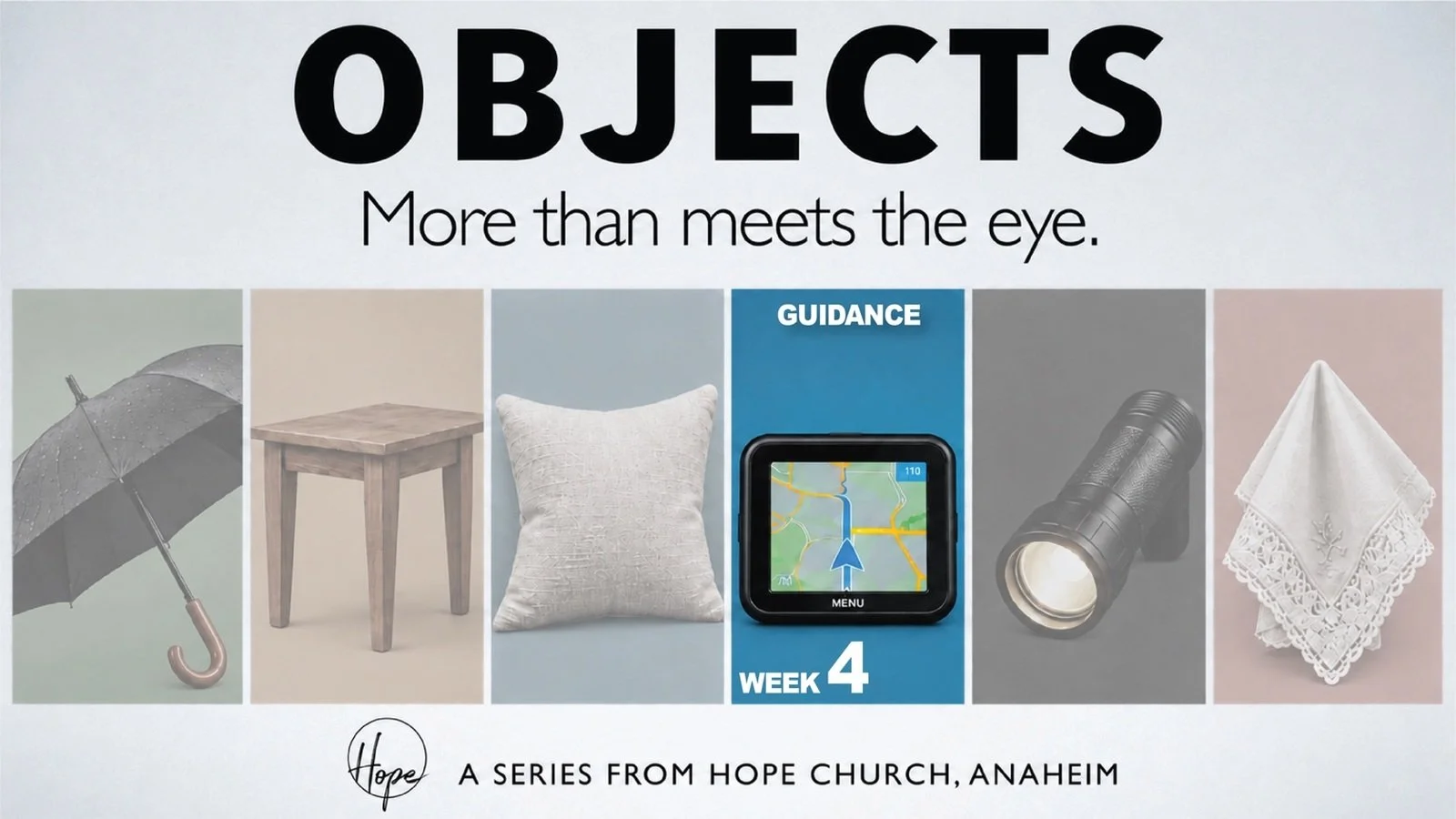
What If God Only Shows You the Next Step?
OBJECTS Sermon Series, Part 4: The GPS
Have you ever wished God would give you a GPS for your life?
Something that would tell you when to turn, when to stop, when to change direction, and when to stay right where you are?
We use GPS technology every day. We enter a destination, and within seconds, we have directions. We don't need to know every turn along the way. We just follow the instructions, one step at a time.
Wouldn't it be wonderful if life's decisions were that simple?
Should I take that job? Is this the right relationship? Should I make a change or stay where I am?
The truth is, God doesn't usually speak to us like the voice on our GPS. But He does promise to guide us.
And sometimes, the hardest part of following God is trusting Him when we can't see where He's taking us.
When God Says Go, But Doesn't Say Where
In Genesis 12, we meet a man named Abram, later known as Abraham.
Abram was 75 years old when God gave him an extraordinary instruction:
"Go from your country, your people and your father's household to the land I will show you." (Genesis 12:1)
Imagine being asked to leave everything familiar behind. Your home, your friends, your family, and the life you've spent decades building.
And when you ask where you're going, the answer is simply, "I'll show you."
God didn't give Abram a map, a timeline, or a detailed explanation. Instead, He made a promise.
He would bless Abram, make him into a great nation, and through him, bless all the peoples of the earth.
There was just one complication. Abram and his wife, Sarai, had no children.
How could God build a great nation through a couple who couldn't conceive?
Abram didn't have the answers. But Genesis 12:4 tells us something remarkable:
"So Abram went, as the Lord had told him."
He trusted God enough to take the next step, even without knowing how the story would unfold.
God Sees What We Cannot
Abram and Sarai eventually reached the land of Canaan, but their journey was far from over.
It would be another 25 years before their son Isaac was born. Abraham was 100 years old when God's promise began to take shape through that child.
Isaac would become the father of Jacob. Jacob, later named Israel, would become the father of the twelve tribes of Israel.
And generations later, Jesus Christ would be born into that same family line.
Matthew 1:1 identifies Jesus as a descendant of Abraham.
Think about that.
When Abraham took his first step of obedience, he couldn't see Isaac. He couldn't see the nation of Israel. And he certainly couldn't see the birth of Jesus generations into the future.
But God could.
Abraham couldn't see where God was leading him, but God knew where the story was going.
We often want to know how everything will turn out before we're willing to move forward. But faith doesn't require us to see the entire journey.
It asks us to trust the One who does.
Three Ways God Guides Us Today
Most of us will never hear an audible voice from heaven telling us which direction to take. So how do we recognize God's guidance in our everyday lives?
1. Through Scripture
"Your word is a lamp for my feet, a light on my path." (Psalm 119:105)
Notice that Scripture is described as a lamp, not a spotlight illuminating the next fifty miles.
A lamp gives us enough light to see the next step.
Sometimes we're waiting for God to reveal what our lives will look like five or ten years from now, while overlooking what He's already teaching us through His Word today.
But there's something important to remember: We can't be guided by Scripture if we aren't spending time reading and understanding it.
2. Through Prayer
James 1:5 reminds us that when we lack wisdom, we should ask God, who gives generously.
Prayer doesn't have to be complicated or eloquent.
Sometimes it's as simple as saying:
"Lord, I don't know what to do. I need Your help. Give me wisdom to recognize what's right and the courage to follow it."
We don't have to figure everything out on our own.
God invites us to ask for His guidance.
3. Through Wise Counsel
"Plans fail for lack of counsel, but with many advisers they succeed." (Proverbs 15:22)
Sometimes we're so focused on what we want that we struggle to see a situation clearly.
That's why we need people in our lives who love God, care about us, and are willing to tell us the truth, even when it's not what we want to hear.
Seeking godly counsel doesn't mean finding someone who will agree with a decision we've already made.
It means being willing to listen.
Scripture, prayer, and wise counsel help us distinguish between what we want and where God may actually be leading us.
What Happens When We Make a Wrong Turn?
Anyone who has used a GPS knows it doesn't always get things right.
Sometimes it sends us down an unfamiliar road, through endless traffic lights, or along a route that seems much worse than the one we were already taking.
But there's something comforting about a GPS when we make a wrong turn.
It recalculates.
It doesn't scold us or give up. It simply finds another route.
And while the comparison isn't perfect, there's a beautiful reminder here about God's grace.
We've all made wrong turns in life. We've made decisions we regret, ignored good advice, or followed our own plans instead of seeking God's direction.
But those mistakes don't mean God is finished with us.
We can turn back to Him.
No matter how many wrong turns we've taken, we can seek His forgiveness, wisdom, and direction for the road ahead.
And unlike a GPS, which sometimes gets things wrong, God is always trustworthy.
That doesn't mean His direction will always lead us down the easiest road. But we can trust Him with the journey.
Learning to Depend on God
There's another interesting thing about using a GPS.
Sometimes we become so accustomed to following its directions that we never actually learn the route.
We might travel to the same destination dozens of times and still depend on our GPS to get us there.
When it comes to technology, that might seem like a weakness.
But when it comes to our relationship with God, dependence is exactly where we want to be.
We aren't supposed to reach a point in our spiritual lives where we no longer need God's guidance.
In fact, spiritual maturity should lead us toward greater dependence on Him, not less.
As Pastor Greg reminded us:
"The goal of following Jesus isn't to get so good at life that you don't need His directions anymore. The goal is to walk so closely with Him that you wouldn't want to take another step without Him."
What a different way to approach our lives.
Instead of automatically relying on our own experience, instincts, or understanding, we can pause and ask God for wisdom.
Even when we think we already know the way.
What's Your Next Step?
Maybe you're facing an important decision right now.
Maybe you're waiting for an answer, struggling with uncertainty, or wondering whether you're headed in the right direction.
You may not receive a complete roadmap for what comes next.
But you can open Scripture, spend time in prayer, seek wise counsel, and trust God with the step in front of you.
Abraham didn't know how his story would unfold when God told him to go.
He simply went.
And thousands of years later, we're still seeing the impact of that obedience.
You don't have to see the whole road to take the next right step.
You just have to keep walking with the One who knows where it leads.
A Thought for This Week
The next time you use your GPS, notice how it gives you one instruction at a time.
Let it remind you to ask:
Am I trusting God with the next step, or am I refusing to move until I can see the entire journey?
And perhaps begin each day with a simple prayer:
Lord, guide my steps today. Help me recognize Your direction, trust Your wisdom, and follow You, even when I can't see what's ahead. Amen.
This post is based on Part 4 of our OBJECTS sermon series, "The GPS," shared by Pastor Greg Tucker at Hope Community Church of Anaheim in Downtown Anaheim, CA.
Watch the full sermon at HopeCCA.com/sermons